
First, the church of the Bible comes from the Greek εκκλησιᾳ (ekklesia) which is best defined by breaking up the syllables. The Greek εκ is defined as “from, out of, or place” (Moulton 121). The Greek κλησιᾳ is “a call, calling, invitation, summon, or as a law-term, of the judge, to cite or summon before… Read More »
The Cord of Blue
The Cord of Blue Numbers 15:37-41 “37 And Jehovah spoke unto Moses, saying, 38 Speak unto the children of Israel, and bid them that they make them fringes in the borders of their garments throughout their generations, and that they put upon the fringe of each border a cord of blue: 39 and it shall be… Read More »
Jehovah
English Bibles often translate the differing Hebrew and Greek Septuagint names for God in the same way. Most Bibles either use Lord or God. Consider the use of “Jehovah” as used by the 1901 American Standard Version Bible: “2 And God (elohim) spoke unto Moses, and said unto him, I am Jehovah (YHWH) 3 and… Read More »
Faithful till Death
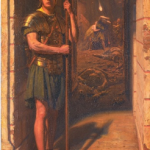
The pictured painting is titled, “Faithful till Death.” It was painted in 1865 by Sir Edward John Poynter. It is a depiction of a Roman soldier holding his post in Pompei during the volcano eruption of Mount Vesuvius in 79 AD. The city was buried under 13 to 20 feet of volcanic ash and pumice… Read More »
Jeremiah Must Die
God sent Jeremiah to preach to Judah due to their sins of idolatry, covetousness, slander, rebellion, and putting their trust in other nations. “8 And it came to pass, when Jeremiah had made an end of speaking all that Jehovah had commanded him to speak unto all the people, that the priests and the prophets… Read More »
Parables
Parables of the Bible give cause for the teaching method of comparative analysis (Matthew 13:10). Parables, like the other methods of comparative teaching, present enigmatic or puzzling information that demands a students’ greatest attention. The Bible is written in such complicated ways for a purpose. Those that love God and believe in his promises will… Read More »
The Nazarite Vow
The term “Nazarite” is defined, by way of similitude, as being separate and holy (Numbers 6:4, 6). One determines to take the vow of a Nazarite that they may display to God a ‘transformed’ way of life. This newly reformed life involves not eating or drinking anything of the grapevine, not coming near the dead,… Read More »
The Feast of Tabernacles
“33 And Jehovah spoke unto Moses, saying, 34 Speak unto the children of Israel, saying, On the fifteenth day of this seventh month is the feast of tabernacles for seven days unto Jehovah” (Leviticus 23:33). The seventh and last feast, festival, or holiday was the feast of tabernacles or booths. The feast of tabernacles began… Read More »
Day of Atonement
“27 On the tenth day of this seventh month is the day of atonement: it shall be a holy convocation unto you, and you shall afflict your souls; and you shall offer an offering made by fire unto Jehovah” (Leviticus 23:26-27). Ten days after the feast of trumpets is the “day of atonement.” Aaron, the… Read More »
The Feast of Trumpets
The Feast of trumpets was the fifth of seven feasts Israel was to observe. If it is the case that the four previous feasts of the Sabbath, Passover, Unleavened Bread, and Pentecost are comparative to Christ, the church, and New Testament truths, then it stands that the Feast of Trumpets does as well (Colossians 2:16-17). … Read More »
- « Previous Page
- 1
- …
- 3
- 4
- 5
- 6
- 7
- Next Page »